
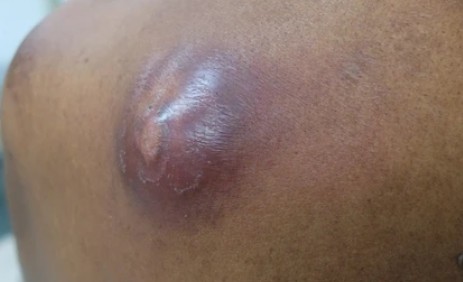
Image of an infected cyst
Introduction to Emergency Treatment For Infected Cysts and Skin Abscesses
An infected cyst or skin abscess is usually more painful and urgent than a simple, non-infected cyst. Treatment is often straightforward but differs from routine cyst removal. In many cases, a minor surgical procedure is required to relieve pain and clear the infection. Before discussing treatment options, it is helpful to understand what an infected cyst or abscess actually is.
An infected cyst develops when bacteria enter a pre-existing cyst, causing inflammation and a build-up of pus. The area becomes red, swollen, tender and warm to the touch. The lump often grows quickly and can feel tight or throbbing. Sometimes it may leak yellow or green fluid, which can have an unpleasant smell.
A skin abscess is similar but does not always start from a cyst. It is a collection of pus that forms under the skin due to infection. Abscesses can develop anywhere on the body and may make you feel generally unwell if the infection is more severe.
Unlike non-infected cysts, which are usually removed for cosmetic reasons, infected cysts and abscesses are treated to relieve pain, prevent the infection spreading, and promote proper healing. Depending on the stage of infection, treatment may involve antibiotics or a small procedure called incision and drainage.
On the page below, we explain the signs of infection, when treatment is necessary, and what to expect from the procedure and recovery.
Our service to treat infected cysts and abscesses is designed for patients wanting to bypass long queues in A&E or want a private and professional local service. Please read the section carefully as some limitations to our service apply.
All about Infected cysts and abscesses: Knowledge section
More About Infected Cysts and Abscesses
Infected cysts and abscesses behave very differently from simple cysts. While a non-infected cyst is usually painless and slow growing, infection causes rapid changes that are often uncomfortable and sometimes alarming.
Pain and Local Symptoms
Pain is one of the most common features of an infected cyst or abscess. The area may feel:
Tender or painful to touch
Throbbing or tight
Increasingly uncomfortable over a short period of time
The skin over the lump often becomes red, swollen and warm. As pus builds up under pressure, the lump can feel tense and may increase in size quite quickly. In some cases, the skin may thin and eventually burst, releasing pus. Although this can temporarily relieve pressure, the infection may not fully clear without proper treatment.
Discharge
If the infection drains spontaneously, the fluid is usually yellow, green or blood-stained pus. It may have an unpleasant smell. Unlike the thick white material sometimes seen in non-infected cysts, pus is a sign of active infection.
Systemic Symptoms
Most small abscesses cause only local symptoms. However, if the infection becomes more significant, you may experience general symptoms such as:
Fever
Feeling unwell or fatigued
Shivering or sweats
Swollen lymph nodes nearby
These symptoms suggest the body is reacting more strongly to the infection. In rare cases, untreated infections can spread into surrounding tissues or into the bloodstream, which requires urgent medical attention.
Why Prompt Assessment Is Important
Because infected cysts and abscesses can worsen quickly, early assessment is sensible. Antibiotics alone are often not enough once pus has formed. The most effective treatment is usually drainage of the infection, which relieves pressure and allows healing to begin properly.
If you are unsure whether a lump is simply inflamed or truly infected, a clinical examination can clarify the diagnosis and guide the correct treatment.
Treatment Options for Infected Cysts and Abscesses
The most appropriate treatment depends on:
The size of the infection
The degree of redness and inflammation
The level of pain
The location on the body
Whether pus has clearly collected
The presence of fever or other systemic symptoms
How unwell the patient feels
Patient preference
Infected cysts and abscesses develop in stages. Treatment that works very well early on may be less effective once a large collection of pus has formed.
1. Antibiotic Treatment (Particularly Effective in Early Stages)
Antibiotics play a very important role in the early stage of an infected cyst or developing abscess.
At this stage, the area is often:
Red
Tender
Swollen
Increasing in size
The skin may appear very red and inflamed. This redness (hyperaemia) means there is increased blood flow to the area. Increased blood flow allows antibiotics to be delivered very effectively to the site of infection.
Because of this, antibiotics can work extremely well in early infections and can sometimes completely reverse an infected cyst or developing abscess before a significant collection of pus forms. Early treatment can prevent progression and may avoid the need for surgery.
Antibiotics are especially important when:
The infection is on the face
There is spreading redness
Pain is increasing
The patient feels unwell
There are underlying health conditions affecting immunity
However, once a large, tense pocket of pus has clearly formed, antibiotics alone are usually less effective. A well-established abscess cavity does not have the same blood supply internally, so antibiotics cannot penetrate it sufficiently to resolve the infection on their own.
2. Local Treatment (Magnesium Sulphate and Supportive Measures)
Local treatment such as magnesium sulphate paste can be helpful, particularly in:
Smaller abscesses
Lower-risk areas of the body
Abscesses that are already “coming to a head”
Magnesium sulphate helps draw the infection towards the surface and may encourage natural drainage. Warm compresses can also support the body’s immune response.
This approach can be particularly appropriate in later-stage abscesses that are well localised and not in dangerous areas, provided there are no systemic symptoms and the pain is manageable.
Careful monitoring is important. If redness spreads, pain worsens, or general symptoms develop, medical reassessment is required.
3. Incision and Drainage
When there is a tense, painful abscess with a significant collection of pus under pressure, incision and drainage is usually the most effective treatment.
This small procedure releases the trapped pus, relieves pressure and allows proper healing.
In some cases, antibiotics are still required alongside surgical drainage, particularly when:
There is significant surrounding redness
The infection is located in a higher-risk area
There are early systemic symptoms
The inflammation remains marked after drainage
Antibiotics may be continued for several days after the procedure to reduce the risk of systemic symptoms and to help settle the surrounding tissue infection while healing begins.
Choosing the Right Approach
Early infected cysts can often be turned around with prompt antibiotic treatment.
More advanced abscesses usually require drainage for reliable resolution.
In some cases, a combination of treatments is necessary.
The correct approach depends on the stage of infection, the location, your overall health, and how you are feeling at the time of assessment. Our aim is always to choose the safest and most effective option based on your individual presentation.
Surgical Treatment: Incision and Drainage
This approach is usually recommended when a significant collection of pus has already formed and earlier medical treatment is unlikely to be sufficient on its own. When a cyst becomes infected and forms a true abscess, incision and drainage is often the most effective treatment. The aim is simple: release the trapped pus, relieve pressure and allow the infection to clear properly.
The Procedure
The area is first numbed with local anaesthetic. A small incision is then made in the skin to allow the pus to drain. The cavity is gently cleaned to remove infected material.
Although local anaesthetic is used, it is important to understand that infected tissue is often very inflamed and sensitive. This means the injection and parts of the procedure can sometimes feel a little tender. We always take care to make the process as comfortable as possible, but some temporary discomfort can occur.
Relief from the pressure pain is usually noticeable very quickly once the abscess has been drained.
Why the Cyst Wall Is Not Usually Removed at This Stage
If the abscess developed from a pre-existing cyst, the cyst wall (also called the cyst sac) is usually still present.
However, during active infection the tissues are swollen, fragile and distorted. Attempting to remove the entire cyst wall at this stage is often not possible and can increase the risk of complications, poor healing, or recurrence.
For this reason, the priority during incision and drainage is to treat the infection safely.
Once the infection has completely settled and the inflammation has resolved, a second planned procedure may be recommended to remove the remaining cyst wall. This is typically a more straightforward minor operation performed under local anaesthetic. Removing the cyst wall reduces the risk of the cyst reforming in the future.
Not every patient will require this second procedure, but it is common when a clear underlying cyst remains.
Why Follow-Up Appointments Are Often Needed
Unlike routine cyst removal, an abscess is not stitched closed. Instead, it is left open intentionally so it can heal safely from the inside out. This reduces the risk of the infection becoming trapped again.
In many cases, the cavity needs to be packed with a sterile dressing material after the procedure. This helps:
Prevent the skin from sealing too quickly
Allow continued drainage
Encourage healing from the base of the cavity upwards
Because of this, follow-up nurse appointments are typically required.
On average, patients may need around six follow-up visits for dressing changes. Some people require fewer appointments, while others may need significantly more, depending on the size of the abscess and how quickly the body heals.
These appointments are an important part of the treatment process and help ensure proper healing and reduce the risk of recurrence.
Healing Time
Healing times vary. Smaller abscesses may settle within a couple of weeks, while larger cavities can take longer to fully close. During this time, mild discomfort and some discharge are normal and gradually improve as healing progresses.
We will always advise you on wound care, what to expect, and when to seek further medical advice.
Cost of Medical Treatment (Non-Surgical)
If your infected cyst or abscess is suitable for medical management, the cost of treatment is £150.
This fee includes:
A full clinical assessment
Prescription of appropriate antibiotics, if indicated
One follow-up appointment
The follow-up can take place either:
Over the phone, or
Face to face in clinic
The cost is the same regardless of whether the follow-up is remote or in person.
Medical treatment is appropriate in selected cases, particularly where the infection is caught early, symptoms are mild, or there is no significant collection of pus requiring drainage. If surgical treatment later becomes necessary, this would be discussed separately.
Cost of Incision and Drainage
The cost of incision and drainage typically ranges between £390 and £790, depending on the size, location and complexity of the abscess.
The total cost is made up of:
-
The initial consultation and assessment – £60
-
The surgical procedure (incision and drainage) – typically £390 – £750
-
Six follow-up nurse appointments for dressing changes (valued at £50 per visit)
Because abscesses are left open to heal from the inside out, these follow-up appointments are an important and expected part of treatment.
If fewer than six nurse appointments are required, any unused appointments can be refunded.
If additional appointments are needed beyond the six included, these are charged at £50 per visit.
It is important to note that this fee does not include the later removal of the underlying cyst, if one is present. As explained above, once the infection has fully settled, a second planned procedure may be recommended to remove the cyst wall. This procedure is usually less expensive than incision and drainage because it does not normally require multiple nurse follow-up appointments.
We will always advise you clearly about expected healing time, follow-up needs, and the possibility of later cyst removal before proceeding with treatment, so you can make an informed decision.
Please note Incision and Drainage is not a consistent service offered by Thames Valley Surgical Services as it includes making appointments available at short notice. Our business hours are Monday to Friday 9am to 6pm. If you require help outside these hours, please enquire with a local private hospital, call NHS 111 or go to A&E depending on the severity of the cyst / abscess symptoms.
Cost of Cyst Removal at a Later Stage
If a residual cyst remains after the infection has completely settled, a planned cyst removal procedure may be recommended.
The cost of cyst removal at a later stage typically ranges between £500 and £900, depending on the size, location and complexity of the cyst.
This is usually a more straightforward procedure than incision and drainage because:
The infection and inflammation have resolved
The tissues are less fragile
The wound can often be closed with stitches
Multiple nurse dressing appointments are not normally required
If laboratory analysis of the removed tissue is appropriate, this will also be arranged.
In most cases, the total combined cost of treatment, including:
Initial incision and drainage
Follow-up appointments
Later cyst removal
Laboratory fees
is usually less than £2000.
We will always discuss costs clearly at each stage so you understand the likely overall treatment pathway before proceeding.
Next steps
If you have an infected cyst or abscess and need an emergency assessment or treatment please contact us over the phone on 07973 663355. You can also send us a message via Whatsapp to check on availability. Please be aware we can only provide this treatment Monday – Friday between 8am and 6pm and appointments depend on clinical and staff availability. However, we are confident we can fit in most cases.
More Information: For a glossary on minor surgery terms, click here
Accessibility & Clinic Location
Our clinic in Bourne End, Buckinghamshire offers easy access for patients across the South East of England seeking expert cyst removal and other minor surgical procedures. We’re strategically positioned near major roadways and connected to London and surrounding counties via excellent public transport links.
📍 Nearby Local Areas (within 20–30 minutes)
Bourne End, Marlow, Henley-on-Thames, Twyford
Maidenhead, Windsor, Ascot, Slough
Gerrards Cross, Beaconsfield, Chalfont St Peter
Uxbridge, West Drayton, Egham
🚆 Easy Access via the Elizabeth Line (West & East London)
We’re directly connected to Central and East London via the Elizabeth Line, making travel fast and simple from:
West London: Paddington, Ealing, Acton, Southall, Hayes
Central London: Bond Street, Tottenham Court Road, Farringdon, Liverpool Street
East London: Whitechapel, Stratford, Ilford, Romford, Chadwell Heath, Shenfield
This makes us an ideal choice for patients looking for cyst removal in London without long waiting lists or inflated city-centre pricing.
🛣️ Convenient from the M4, M40 & A404
Easily accessible from key regional towns including:
Bracknell, Reading, Wokingham, Staines, Virginia Water
Richmond, Twickenham, Northolt, Harrow, Wembley
Woking, Farnborough, Guildford, Basingstoke
🌍 Wider Regions (within 45 minutes to 2 hours)
Many patients also travel to us from:
Oxfordshire: Oxford, Banbury, Thame, Didcot
Buckinghamshire & Milton Keynes
South East counties: Surrey, Hampshire, Sussex, Kent, Essex
South Coast: Southampton, Portsmouth, Brighton, Eastbourne
South West: Swindon, Bath, Bristol
Even parts of South Wales, via the M4
🧭 Why Patients Travel to Us
Patients choose us from across the region for our:
Fast access with minimal travel time
Convenient online booking and flexible consultation options
Reputation for safe, efficient, and pain-free cyst removal