
Introduction:
This guide will help you recognise the signs of an infected cyst, understand what is happening beneath your skin and feel more confident about what to do next.
You may have had a small lump beneath your skin for months, perhaps even years, without it causing any trouble. Then something changes. You just “become aware” of the area. I so often hear this from patients, it is one of the earliest signs. And in fact, I see them and then a few days later the cyst starts changing, becoming infected.
The area then often initially starts itching, becomes a little red and suddenly looks a bit bigger. This is when your partner may recognise it. And some patients come at this stage to see me. But if not, the cyst then may become tender or suddenly swells up to many times the size it was before.
Naturally, you might wonder whether the cyst has become infected and what you should do about it.
The good news is that most skin cysts are harmless. Even when they become inflamed or infected, treatment is usually straightforward. However, recognising the early warning signs can help you avoid unnecessary discomfort and know when to seek medical advice.
At Thames Valley Surgical Services, we regularly see patients whose previously harmless cysts have suddenly become painful or swollen. Sometimes the changes develop gradually over several days. In other cases, patients wake up to find that a lump has become considerably larger overnight.
Understanding what happens beneath the skin can help explain these changes.
What is a skin cyst?
A skin cyst is a small sac or pocket that develops beneath the surface of the skin. One of the most common types is an epidermoid cyst, often referred to as a sebaceous cyst. These cysts contain keratin, a natural protein found in your skin, hair and nails. It originates from the inner surface of the skin. They can appear almost anywhere on the body, although they commonly develop on the back, chest, neck, scalp and face. Most feel like a rounded lump beneath the skin. Some are quite firm, while others feel slightly rubbery and move a little when you press them. Some remain unchanged for years and never cause a problem. Typically, they grow slowly over time and increase in size by shedding more of their internal surface to the inside of the cyst.
Occasionally, however, and often quite suddenly, a cyst becomes irritated, inflamed or infected. This is usually the case when the cyst gets really over-stretched and breaks in one place. The contents are extremely irritant and that’s when the process of inflammation, infection and abscess starts. And abscesses can reach huge sizes, often several times the size of the underlying cyst.
Why does a cyst suddenly become inflamed or infected?
One of the most common questions patients ask is why a cyst that has been harmless for years suddenly becomes painful. I have explained this already before, to some extent. Generally, the explanation lies in what happens to the cyst wall.
As explained before, An epidermoid cyst contains keratin within a thin capsule beneath the skin. Normally, this material remains contained. However, the capsule can sometimes rupture, allowing keratin to escape into the surrounding tissues.
Unlike a lipoma (which is a sterile mass of fat) an epidermoid cyst often contains material colonised by bacteria, even when it is completely harmless and causes no symptoms. When the cyst wall ruptures, this material escapes into the surrounding tissues. The keratin itself is highly irritating and triggers inflammation, but bacteria released with it may also contribute to a developing infection or abscess.
This explains why a cyst can suddenly become very painful and swollen without necessarily always needing antibiotics. It also explains why some cysts eventually open and drain spontaneously.
Early signs – Itching or irritation around the cyst
One of the earliest changes patients sometimes notice is itching. This feeling of itch can even be preceded by just an awareness that they have the cyst (which is common on the back, where people otherwise tend to ignore them) That can be due to very small amounts of contents of the cyst spilling under the skin. It may start after you have knocked the cyst or just out of the blue. But because the contents are irritant and sometimes also infected things now start to take their own course.
At this stage you might find yourself rubbing the area more frequently or becoming unusually aware of the lump beneath your clothing. This is often when patients seek help. Itching does not necessarily mean the cyst will definitely become infected soon. Friction, dry skin or irritation of the overlying skin can also cause it.
However, in our clinical experience, patients frequently describe a recognisable sequence: the cyst starts to become more noticeable, starts itching, grows in size, gets red, becomes tender and then develops into a big and painful swelling over the following days.
The 4 Cardinal Signs of Inflammation (according to Aulus Cornelius Celsus 1st century AD)
The 4 cardinal signs of inflammation, as told in medical school in Latin, are:
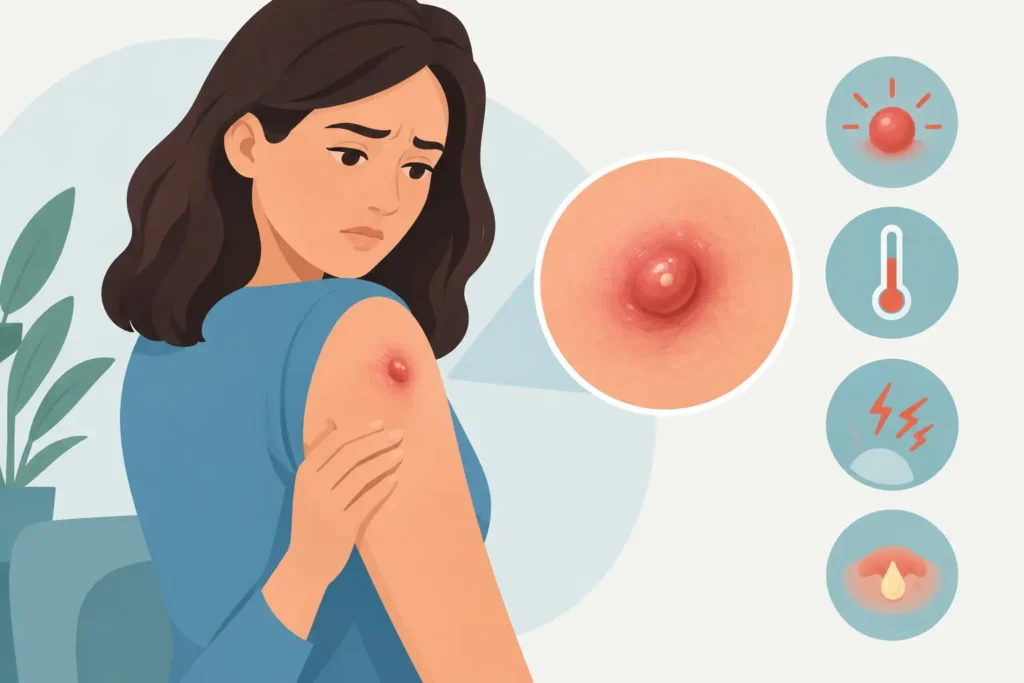
Calor (heat), Dolor (pain), Rubor (redness) and Tumor (swelling).
All four signs can coexist without bacterial infection. However, in my clinical experience, when a cyst develops an increasing number of these signs, particularly when they worsen over time, the likelihood of infection increases.
Increasing pain and tenderness
When the cyst ruptures under the skin it releases irritant contents, which frequently may contain bacteria. If the content is sterile, it mainly causes irritation and redness. They can settle quite quickly and on their own. I often find patients whose cysts have visibly ruptured on several occasions and healed again prior to removal.
In terms of your own symptoms you may notice a dull ache, tenderness when touching the lump or a throbbing sensation beneath the skin. As the swelling increases, everyday activities can become uncomfortable.
A cyst on your back might hurt when you lean against a chair. One near your waistband may rub painfully against your clothing, while a cyst on the scalp can make brushing your hair uncomfortable.
Sometimes patients describe a feeling of pressure building beneath the skin.
This happens because inflammation causes swelling in the surrounding tissues. If fluid or pus begins to collect, the pressure can increase further.
Redness and warmth around the lump (rubor and calor) and danger signs
So, how does this redness look in a cyst? You might notice a pink or red area developing over the lump, sometimes extending into the surrounding skin. On darker skin, the area may appear darker or purplish rather than obviously red.
The skin may also feel noticeably warmer than the rest of your body.
These changes occur because your immune system increases blood flow to the affected area as part of its response to inflammation or infection.
While redness alone may be absolutely fine and settling soon, pay attention to the following:
- If it remains localised, it may simply reflect inflammation around the cyst.
- If it begins spreading further into the surrounding skin, it could indicate cellulitis, a bacterial infection of the deeper skin layers and this can be quite dangerous and will need prompt medical intervention. If you are not sure draw a ring around the redness and if it has spread 2 hrs later, you need to be seeking help promptly. So again:
Spreading redness, particularly when accompanied by increasing pain or fever (could indicate sepsis), needs prompt medical assessment.
Sudden swelling or rapid growth (tumor)
Most uncomplicated cysts grow slowly. Some remain almost exactly the same size for years. When a cyst suddenly becomes much larger over a day or two, it often means something has changed beneath the skin.
One possible explanation is that the cyst wall has ruptured, allowing its contents to escape into the surrounding tissues.
Your body then produces an inflammatory response, which can cause quite dramatic swelling.
Alternatively, an infection may lead to a collection of pus beneath the skin. The lump may become rounder, tighter or noticeably more prominent. Sometimes the skin over it looks stretched or shiny. Patients occasionally describe the sensation as though the cyst is about to burst.
Again, rapid swelling does not automatically mean infection, but it does deserve attention as other differential diagnoses also have to be excluded. A cyst is not always just a benign cyst, other possibilities, albeit uncommon, need to be considered.
A doctor can examine the lump and assess whether it is an inflamed cyst, an infected cyst, an abscess or something completely different.
A soft or squishy centre
A cyst that previously felt firm may start to feel softer as its contents change or fluid collects beneath the skin. Sometimes the centre feels almost as though liquid is moving underneath. Doctors call this fluctuance.
When a painful, swollen lump develops a soft centre, particularly alongside redness and warmth, it may indicate that an abscess has formed. An abscess is a collection of pus beneath the skin. A well-established abscess may need a small surgical opening to release the trapped material. This is known as incision and drainage, or I&D.
There is an old surgical principle, ubi pus, ibi evacua, meaning that where there is pus, it should be evacuated.
Releasing trapped pus can relieve pressure, reduce discomfort and allow the tissues to recover. However, a soft centre does not automatically confirm an abscess. A clinician will assess the lump before deciding whether drainage is necessary.
Discharge, pus or an unpleasant smell
Sometimes a cyst opens spontaneously and begins to discharge. You might notice a small stain on your clothing or see thick, white or yellow material coming from an opening in the skin. Occasionally, the discharge has a strong, unpleasant smell.
Although this can be alarming, it does not always mean that the cyst is dangerous. A thick wall keeps the cyst isolated from its surrounding areas and keeps it safe under the skin.
The keratin inside an epidermoid cyst often has a thick, cheese-like consistency and can smell unpleasant. It compares a little with rancid butter or badly dried clothes.
Fresh pus, particularly when accompanied by increasing pain, swelling, warmth or spreading redness, makes bacterial infection more likely.
Sometimes a small amount of blood is also present, especially if the skin has become irritated or the cyst has opened.
Is it safe to squeeze a cyst that is discharging?
Many people instinctively apply pressure to a cyst once it starts leaking. This is understandable, especially if releasing some of the contents seems to ease the discomfort. And according to “ubi pus ibi evacua” it is not wrong.
Allowing a cyst or abscess to drain can certainly be beneficial. However, there is a difference between gently cleaning away material that has already escaped and trying to force the contents out of an inflamed lump. Excessive pressure can damage the surrounding tissues and may push some of the cyst contents further beneath the skin, potentially increasing inflammation, worsening an existing infection or contributing to further abscess formation. In rare cases, a serious infection can lead to sepsis.
If your cyst opens naturally, gently wipe away the discharge, keep the surrounding skin clean and cover the area with a suitable dressing. Avoid aggressive squeezing, repeated pressure or attempting to puncture the skin with a needle as this will take knowledge about abscess treatment.
If the lump remains tense, painful or only partly drained, a clinician can assess whether a small incision would help. The aim is to let the contents escape safely with creating as little additional irritation as possible
Fever or feeling generally unwell – Sepsis alert
Most inflamed or infected cysts cause symptoms only around the lump itself. You may have redness, swelling and discomfort but otherwise feel perfectly well. Occasionally, however, a bacterial infection becomes more significant. You might develop a temperature, feel shivery or experience unusual tiredness and flu-like aches. Some patients also notice swollen glands near the affected area.
These symptoms suggest that the infection may be affecting more than just the cyst.
If you begin to feel generally unwell, particularly alongside spreading redness or worsening pain, arrange urgent medical advice. Patients with diabetes, poor circulation, reduced immunity or other significant medical conditions should seek advice earlier, as infections are likely to progress more quickly.
Can magnesium sulphate dressings help?
Magnesium sulphate paste has been used for many years as a traditional drawing preparation for boils and localised skin swellings. Some patients find that magnesium sulphate dressings help a superficial swelling soften or begin to discharge.
Although evidence that these preparations reliably draw pus from a deeper abscess is limited, they remain a familiar supportive treatment for minor skin problems. A pharmacist can advise whether a particular preparation is appropriate and how to use it safely.
Another option is a clean, warm compress applied gently for around 10 to 15 minutes. Warmth may ease discomfort and sometimes encourage maturation followed eventually by spontaneous drainage. Neither approach replaces medical treatment when there is significant infection, spreading redness or a painful abscess.
If the swelling continues to increase or the cyst becomes very painful, arranging an urgent assessment is the sensible next step.
Do you need antibiotics for an infected cyst?
This is an interesting question, and one where doctors sometimes take different approaches.
In primary care, antibiotics are frequently prescribed when a cyst becomes red, swollen or painful. Sometimes this is because an infection is suspected, but there can also be an expectation from patients that they should receive some form of treatment.
However, not every inflamed cyst needs antibiotics. As explained earlier, a cyst can become extremely inflamed following rupture of its capsule without necessarily developing a significant bacterial infection. In these situations, antibiotics may offer little benefit.
In my clinical experience, antibiotics can sometimes dramatically reduce the inflammation and swelling around a cyst. This can be particularly helpful when pain is a dominant symptom. However, there is another side to this.
Sometimes antibiotics reduce the inflammation without allowing the cyst or abscess to come to a head and discharge naturally. The lump may then take longer to settle completely, and the underlying cyst remains. This is an observation from clinical practice rather than a proven disadvantage of antibiotics.
For patients who feel otherwise well, have no fever or spreading infection, and have a relatively small, localised swelling, conservative treatment with careful observation may be appropriate. On the other hand, I am certainly not against using antibiotics.
I frequently prescribe them when pain and inflammation are particularly troublesome and I suspect a bacterial component. They can provide considerable relief when bacterial infection is contributing to the symptoms. I am also more inclined to prescribe antibiotics when patients have diabetes, a weakened immune system, are particularly frail or elderly, or show additional signs suggesting a more significant infection. Spreading redness or cellulitis is another important reason to consider antibiotic treatment.
Of course, once a substantial abscess has formed, antibiotics alone may not be enough. The collection of pus may need to be drained. Occasionally, patients develop a more serious infection requiring hospital treatment and intravenous antibiotics. The decision is therefore not just whether a cyst looks infected. It depends on the symptoms, examination findings, the patient’s general health and whether there is a collection of pus that needs releasing. My approach is to consider all these factors rather than automatically prescribing antibiotics for every red or painful cyst.
When should you seek urgent medical attention?
Most cyst problems are not emergencies. Even when a cyst becomes inflamed or infected, treatment is usually straightforward, particularly when the problem remains localised. However, certain symptoms deserve prompt attention.
Seek same-day medical advice if:
- Redness spreads beyond the original lump.
- Pain becomes severe or increases rapidly.
- The swelling continues to enlarge.
- You develop a fever, chills or feel generally unwell.
- There is significant pus or worsening discharge.
- The swelling affects the area around your eye or the genital region.
- You have diabetes, a weakened immune system or other conditions that increase your risk of complications.
Your GP or NHS 111 can advise on the most appropriate next step.
Sepsis: when urgent hospital treatment is essential
Although sepsis is uncommon following a simple skin cyst, it is important to recognise the warning signs.
Sepsis is a potentially life-threatening condition in which the body’s response to an infection begins to damage its own tissues and organs.
Symptoms can develop quickly and do not always include a high temperature.
Warning signs include:
- New confusion, disorientation or slurred speech.
- Severe shivering or feeling profoundly unwell.
- Rapid breathing or significant breathlessness.
- A very fast heartbeat accompanied by dizziness, severe weakness or collapse.
- Pale, blue, grey or mottled skin.
- Passing very little urine or not passing urine for many hours.
- A very high or unusually low body temperature alongside other signs of serious illness.
If you suspect sepsis, call 999 or attend A&E immediately. Do not wait for a private minor surgery appointment.
Patients with suspected sepsis require emergency hospital assessment. They may need admission, intravenous antibiotics, fluids and close monitoring.
At Thames Valley Surgical Services, we treat suitable localised cysts and superficial abscesses. Serious systemic infections require hospital care.
Fortunately, the great majority of patients with an inflamed or infected cyst will never develop sepsis.
The important thing is knowing when an apparently local problem has become something more serious.
What can you do while waiting for an appointment?
If your cyst has become irritated or started discharging, there are several simple ways to keep the area comfortable.
- Keep the surrounding skin clean and avoid unnecessary friction from clothing.
- If the cyst has opened, cover it with a clean dressing and change the dressing when it becomes wet or soiled.
- A warm compress may help ease discomfort.
- Magnesium Sulphate Paste can support maturation and drainage.
- Simple pain relief, such as paracetamol, may also be suitable if you can take it safely. Always follow the instructions on the packet.
- Try to avoid repeatedly pressing or manipulating the lump.
- If it begins to discharge naturally, gently clean away the material rather than forcing more out.
- Avoid attempting to open a cyst yourself with a needle, blade or other sharp instrument.
- Most importantly, monitor how you feel.
A mildly inflamed cyst that gradually improves is very different from one that becomes increasingly painful, swollen or associated with fever.
Does an infected cyst always need two operations?
Not necessarily. When an infected cyst develops into an abscess, the immediate priority is to release the pus, relieve pressure and control the infection. A conventional incision and drainage procedure focuses on achieving this.
Thus, if the abscess developed from an existing cyst, some or all of its capsule may remain beneath the skin. This residual wall can allow the cyst to refill or recur, potentially requiring another procedure once the inflammation has settled. However, often the cyst shrinks to almost no size at all. This is a process called “Involution”. A removal is no longer necessary. It may take years for the cyst to grow again. Occasionally complete cure is achieved with Incision and Drainage alone.
At Thames Valley Surgical Services, our experience in minor surgery allows us to take a more comprehensive approach in suitable cases. During the initial drainage procedure, I can often identify and carefully remove remnants of the cyst capsule, even when inflammation has made the tissue soft and fragile. This requires judgement, experience and a thorough understanding of the surrounding tissues.
In my clinical experience, carefully removing the remaining cyst capsule during the initial drainage procedure, where it is safe to do so, often allows the wound to heal more quickly and reduces the likelihood of further surgery. The aim is not just to release the pus but, where safely possible, to remove the underlying cyst material that might otherwise cause further problems. The wound is then managed appropriately, often allowing it to heal gradually from the inside out, with dressing care and planned reviews.
Complete removal is not always possible during an acute infection. Sometimes the inflammation is too extensive, the capsule cannot be safely identified, or the surrounding tissues are unsuitable. In these circumstances, treating the infection takes priority, and a later procedure may still be recommended.
For a detailed explanation of the procedure, recovery and follow-up care, see our page on emergency infected cyst and abscess treatment.
Should you have an infected cyst treated privately or through the NHS?
Patients often ask whether they need private treatment for an infected cyst. The answer is no. The NHS provides treatment for medically necessary skin infections, and eligible patients can receive care without paying privately. Depending on the symptoms, your GP, NHS 111 or an urgent treatment centre may be the appropriate first point of contact. A&E is generally more appropriate for serious or rapidly worsening illness.
The treatment available at a particular NHS facility can vary according to staffing, clinical circumstances and local services. Sometimes a clinician can drain an abscess during the initial visit. In other circumstances, patients may receive antibiotics, require referral or need to return for a procedure.
Private treatment offers a different option.
At Thames Valley Surgical Services, we aim to provide prompt appointments, subject to availability and clinical suitability, in a comfortable private setting. Patients benefit from an experienced minor surgery team, a clear explanation of the available treatment options and scheduled review appointments to monitor healing.
Continuity of care is particularly helpful when a wound needs dressings or follow-up assessment. But if you live further away we are very happy to hand over the packing of the wound to our very competent NHS nurse colleagues in your local practice after 1 or 2 follow up appointments to ensure your wound is healing appropriately.
We are transparent about the alternatives. If NHS treatment is appropriate, we are happy to explain that patients may be able to receive care without paying privately. Equally, patients who prefer a planned appointment, a familiar clinical team and a more personalised treatment experience may choose private care. What matters is that you understand the options and can make an informed decision.